
If you’re running a SaaS business, chances are your SEO playbook has been built on broad informational keywords: “what is [category],” “how to improve [problem],” “best [X] tools.” That worked when Google was handing out traffic like free beer at a startup party.
Now? Google’s AI Overviews are eating those clicks alive. CTR drops by 30–35% on queries with AI summaries. The low quality traffic is evaporating, and the little that’s left is harder to win.
The good news: not all traffic is created equal. And the traffic you actually want where people are ready to try, buy, compare, or shortlist can still be won.
1. Stop obsessing over ToFu and move down the funnel
Traffic Think Tank and PoweredBySearch both say the same thing: most SaaS companies over-invested in broad “what is” content. Great for impressions, lousy for pipeline.
I should know. I’ve written more “what are” and “what is” articles than I’d like to admit, and most of them now live rent-free inside Google’s AI data soup.
Many years ago, meeting scheduler tools would all compete on queries like “What are meeting scheduling tools” or “What do meeting scheduling tools do?”.
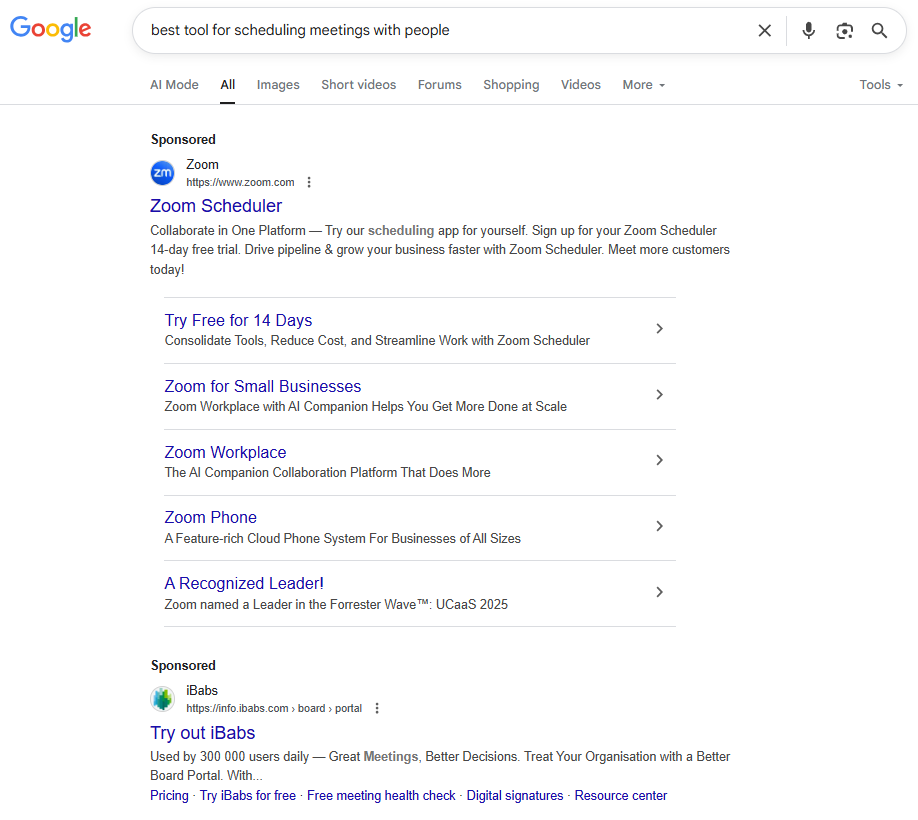
Now? Those clicks are owned by the AI overview, and Google. And the search results that are shown lean more towards actual apps (or list of apps) rather than information blog posts.
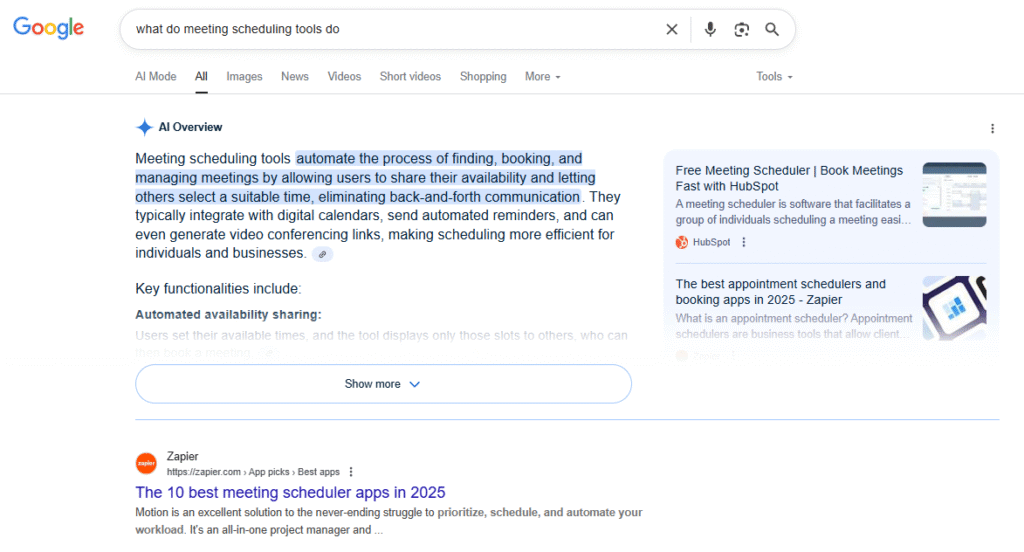
Instead, content writers and the strategists that herd them, need to focus on MoFu (solution-oriented) and BoFu (transactional) keywords. Think:
- “[Your category] software comparison”
- “Best [category] tool for [specific persona/use case]”
- “Alternatives to [competitor]”
- “[Your product] pricing”
You might not be guaranteed a click, but at least you’re only competing with a wall of sponsored ads rather than a robot!
2. Build topic clusters, not one-off articles
Mike Khorev and others recommend clustering: one pillar page on a core category term, supported by multiple specific subpages. This creates semantic depth that both Google and LLMs love.
Example: Instead of one page on “audience engagement tools,” you’d build:
- Pillar: “Audience Engagement Software: The Complete Guide”
- Subpages: “Audience Engagement for Webinars,” “Audience Engagement in Microsoft Teams,” “How to Measure Audience Engagement”
SEO tools like Ahrefs or Serpstat can help here by showing which clusters are already being cannibalized by AI Overviews, and where long-tail opportunities remain.
How we used programmatic SEO to build our topic clusters
At StreamAlive, we initially leaned into programmatic SEO because it was faster and easier to execute with a small team. pSEO let us generate lots of pages around engagement formats, platforms, and scenarios without heavy editorial overhead.
For early traction and long-tail coverage, it worked well enough. Pages got indexed quickly, picked up impressions, and captured low-intent searches that would have been hard to justify writing bespoke content for.
The limitation showed up later. Programmatic pages are good at coverage but weak at narrative and authority. As AI Overviews and LLM-driven answers became more dominant, it became clear that clusters built around a strong pillar do a better job of signalling real understanding.
A handful of deeply connected pages that explain the problem, the context, and the trade-offs consistently outperform dozens of thin variants when it comes to trust, synthesis, and brand recall. In hindsight, pSEO was a useful shortcut early on, but topic clusters are the more durable strategy when search shifts from keywords to concepts.
3. Mine your customers for keyword gold
Forget keyword tools for a second. The best SaaS keywords come from sales calls, support tickets, community chatter, and forums. SEOProfy and RockTheRankings both stress this: your customers don’t type like SEOs, they type like people with problems.
Practical step: export a batch of call transcripts or Zendesk tickets, run them through an LLM, and pull out recurring questions. That’s your keyword list.
And yes, tools like Surfer SEO or MarketMuse can still be useful here. It’s not to chase volume, but to make sure the real language from your customers aligns with content that search engines and LLMs can parse.
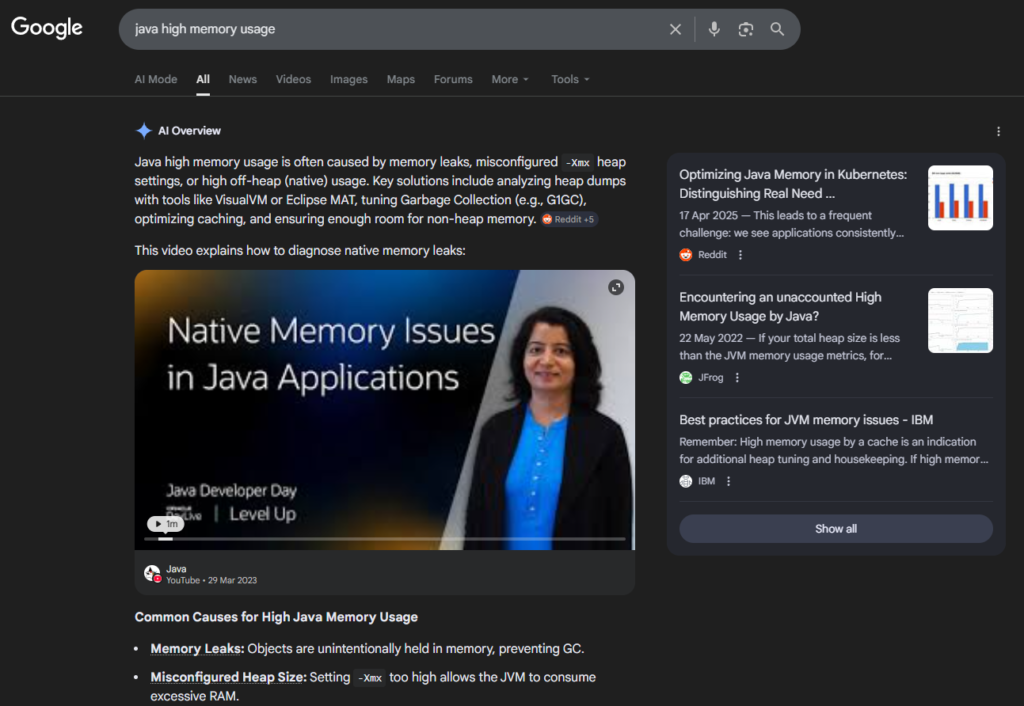
At eG Innovations, the company’s best-performing keywords were based on what keyword tools told us were relatively high traffic and low competition. Keywords like “high Java cpu” and “high Java memory” and “what is application performance monitoring”.
Those terms used to be SEO gold. Today, many of them trigger AI Overviews or get answered directly in ChatGPT, which means the click is often gone. However, even when the search result is summarized, the brands that show up in those summaries tend to be the ones that historically explained the problem clearly and repeatedly.
4. Balance branded vs non-branded keywords
B2B software categories are seeing ~30% CTR drops in the organic search results as AI overviews eat your clicks. The painful reality, as PR Daily notes, is that only ~16% of B2B search queries now result in actual clicks.
Mailchimp is battling this by optimising their site to better serve AI “crawlers” by prioritizing technical performance (fast load times, machine-readable markup) because these elements matter more for LLM ingestion than for traditional human-first SEO.
Elsewhere, ecommerce sites are reporting 40% CTR drops on product terms buyers use to find products according to PassionFruit. Maybe thank your lucky stars you’re not an ecommerce owner right now?
But is on-site SEO enough?
Quoleady and Victorious argue SaaS companies underestimate the power of branded search. If buyers are already using AI or communities to narrow their options, you want them typing your name into Google.
That means investing in:
- Brand-building campaigns
- Customer advocacy and reviews
- Consistent naming in communities and roundups
The boring truth: when demand capture shrinks, demand creation matters more.
Capturing demand is measurable. Creating demand is uncomfortable.
When I was at eG Innovations, SEO and paid search were almost entirely about capturing existing demand.
Keywords, comparison pages, and bottom-of-funnel content won because they could be tied directly to pipeline. Demand generation was treated with suspicion because it couldn’t be tied to new leads.
We tested digital PR and brand activity, but when spending $2,500/mo didn’t produce leads inside the reporting window, the budget was pulled.
The CFO wasn’t wrong from a spreadsheet perspective. The company’s priority was profitability, and profitability demanded revenue now. Longer time horizons, softer metrics, and indirect effects like lower CAC or shorter sales cycles were not acceptable trade-offs.
At StreamAlive, the approach is almost the opposite. Community building, content, and brand come first, even though most of it can’t be cleanly attributed to leads.
Newsletters, education, weekly workshops, community, product-led sharing, and opinionated content create familiarity long before purchase intent exists.
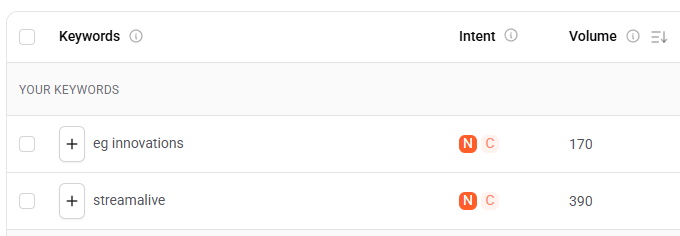
The difference shows up clearly in brand search demand.
eG is a 25-year-old company with 250 employees and roughly $30m in revenue, yet brand search is modest relative to its size. StreamAlive, with three years in market and a ten-person team, generates disproportionate branded search interest. That’s the compound effect of creating demand early, even when it’s uncomfortable to measure.
5. Prepare for Generative Engine Optimization (GEO)
We’re entering the era of Generative Engine Optimization. That means:
- Write structured, FAQ-style answers
- Use schema markup where possible
- Format for clarity (headings, bullets, summaries)
- Publish in multiple formats (text, video, docs)
Our own experiments at StreamAlive showed that multi-format content (video + blog + docs) increased the odds of being pulled into AI summaries. LLMs need structured, digestible content. Give it to them, and they cite you.
Elsewhere, a Wall Street Journal piece highlights how Back Market (specialising in refurbished tech for consumers) is tweaking product pages with a more conversational tone to better align with how LLMs like ChatGPT parse content. AI referrals are still small (about 0.2%), but growing rapidly (470× since last summer).
How StreamAlive is dominating the search results
StreamAlive experienced a 28% drop in search traffic between March 2025 (when AI Overviews were fully unleashed) and July 2025.
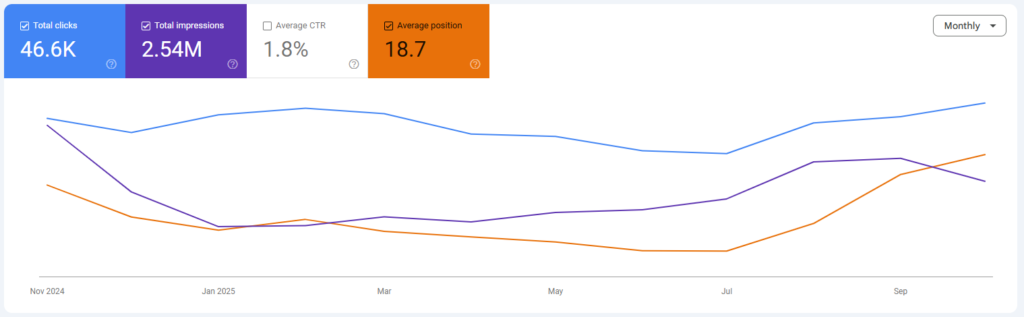
We’ve fought back by creating product pages, blog posts, and use case pages for each of our features. We also doubled down on video.
Every keyword we want to rank for has a corresponding video.
The result has been nothing short of spectacular.
The search results for dozens of keywords that we’re targeting now look like this 👇
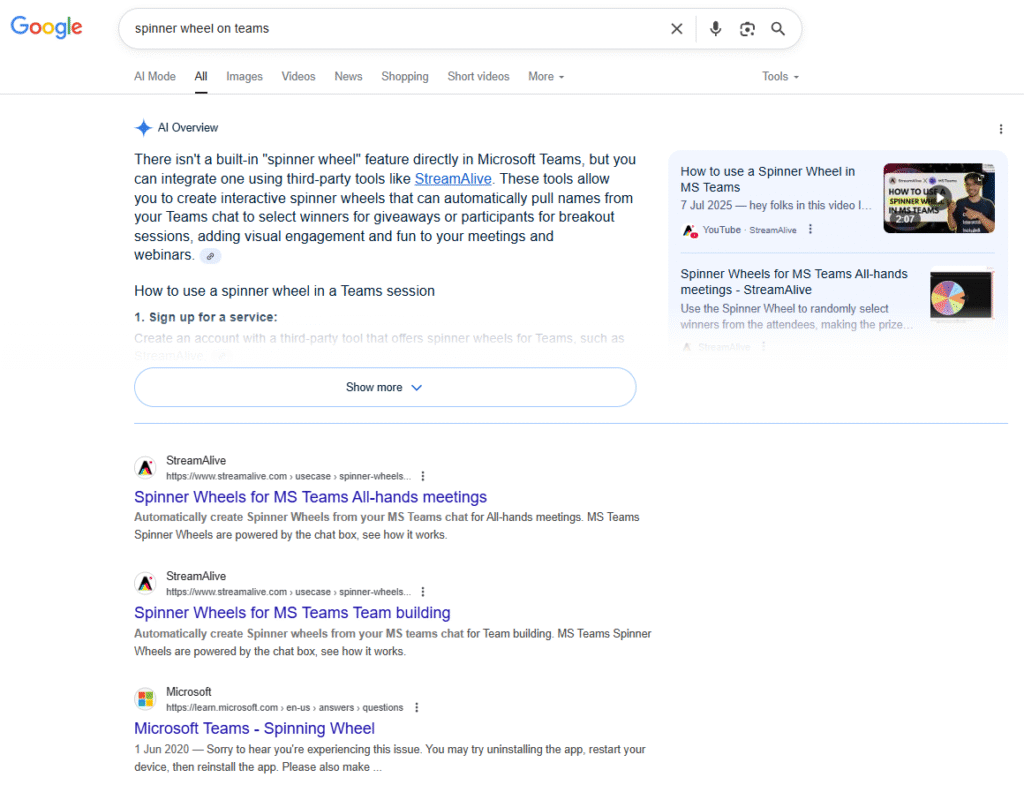
And StreamAlive’s use case pages (built using programmatic SEO) are the top ranking pages, beating Microsoft and other larger brands.
What you’re seeing is StreamAlive being prominently featured in the AI overview, including a step by step tutorial on how to use StreamAlive. There are video links for more information.
Impressions have increased significantly as we now get more visibility in the search results, but of course, AI is eating all the clicks so the CTR is down.
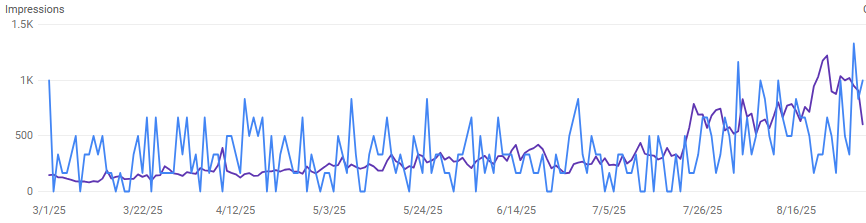
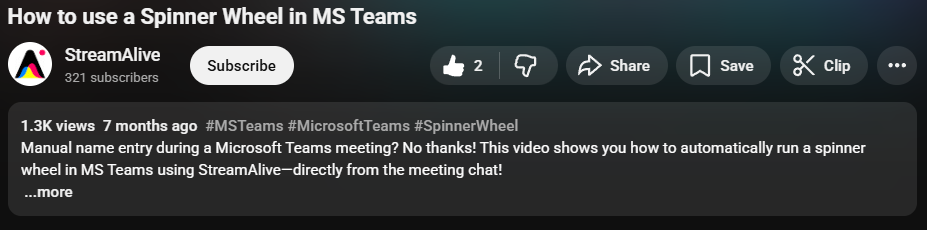
Some of the clicks could be going to our YouTube videos where we’re seeing thousands of views on what are otherwise VERY niche (but targeted!) videos.
A quick word on llm.txt
Some SEOs have been hyping a special llm.txt file that supposedly tells AI models which content to ingest. Right now, it is a placebo. OpenAI has said they ignore it, and no major AI providers fetch it. It feels a lot like the old “meta keywords” tag—a nice idea, but functionally useless.
My view: don’t waste cycles fiddling with llm.txt. Invest that energy into structured content, brand building, and clarity. If I’m wrong, fine—I’ll be the guy who wrote more “what is” articles and more llm.txt files than anyone ever asked for.
Wrapping up
SEO isn’t dead. It’s just shedding the vanity traffic that made dashboards look good but pipelines look thin.
If you focus on high-intent keywords, clusters, customer language, brand demand, and AI-ready content, you’ll not only recover visibility—you’ll get better visitors than before.
If you’re staring at falling traffic and wondering how to adapt, let’s talk. Book a clarity call and we’ll figure out how your SaaS can survive (and maybe even grow) in the AI search era.